Rendering fireEngine's first triangle
Upload vertex and uniform data, record a Vulkan 1.4 dynamic-rendering draw, submit it with Synchronization 2, and present fireEngine's first triangle.
Release 0.5 prepared one frame in flight: a command pool, primary command buffer, acquisition semaphore, completion fence, and one presentation semaphore per swapchain image. Release 0.6 puts every one of those objects to work and renders fireEngine’s first triangle.
The application now uploads three coloured vertices and a per-frame transform, records a dynamic-rendering draw, submits it to the graphics queue with Synchronization 2, and sends the completed swapchain image to the presentation queue. The GLFW window stays open until the user closes it, while a bounded --frames mode lets CTest render one complete frame and exit automatically.
This is the first release where successful startup is no longer the visible result. A pixel reaches the screen only when buffer ownership, shader interfaces, command state, image layouts, synchronization scopes, queue capabilities, and presentation lifetime all agree.
This post follows the changes from release 0.5 to release 0.6. Code links are pinned to 0.6 so the walkthrough continues to match the published source as fireEngine evolves.
Source: fireEngine 0.6
Start with the 0.5 frame-in-flight post for the command and synchronization ownership prepared by the previous checkpoint. This post concentrates on buffer data, command recording, queue submission, and the first presented frame.
Introducing the first complete rendering path
Release 0.6 introduces six connected pieces:
- an allocated buffer owns a Vulkan buffer and the VMA allocation bound to it, providing one reusable path for host-written vertex and uniform data;
- a vertex buffer stores the three positions and colours consumed by the pipeline’s vertex-input interface;
- a uniform buffer stores one 4×4 transform for each frame slot and reaches the vertex shader through a push descriptor;
- a renderer owns the triangle and frame state, then hides the acquire, record, submit, and present sequence behind
renderFrame(); - dynamic rendering commands describe the colour attachment directly, without creating a render pass or framebuffer; and
- Synchronization 2 gives image barriers and queue submission explicit stage and access scopes.
Traditional Vulkan rendering uses a render-pass object to describe attachment use and a VkFramebuffer object to associate specific attachment image views with that description. These objects remain supported and useful. They are different from GLFW’s framebuffer size, which is simply the drawable window size in pixels.
The vertex buffer and uniform buffer solve different shader inputs. The vertex buffer is an array: three Vertex values are fetched once per vertex. The uniform buffer is shared draw state: one FrameUniforms value supplies the same transform to all three vertices. A uniform buffer is therefore not “for” the vertex buffer, even though both are read by the vertex stage.
There is also still no allocated descriptor set. The pipeline has a descriptor-set layout, but Vulkan 1.4 push descriptors copy one descriptor write directly into the command buffer. That distinction keeps this first draw free from descriptor-pool and descriptor-set allocation while preserving the same shader-visible set and binding model.
Extend the ownership and execution chains
The new C++ ownership relationships are:
1
2
3
4
5
6
7
8
9
10
11
12
13
14
15
main
    -> GLFW
    -> Window
    -> Device
    -> MemoryAllocator
    -> Swapchain
    -> Pipeline
    -> Renderer
        -> triangle AllocatedBuffer
        -> FrameInFlight
            -> uniform AllocatedBuffer
            -> command pool
                -> primary command buffer
            -> image-available semaphore
            -> frame-finished fence
Renderer borrows Device, Swapchain, and Pipeline. Its two AllocatedBuffer objects borrow the VMA allocator. Declaration order in main() makes the renderer die before every owner it depends on.
One call to renderFrame() follows a different, execution-time chain:
1
2
3
4
5
6
7
wait for the frame fence
    -> acquire a swapchain image
        -> reset the command pool
            -> record commands for the acquired image
                -> reset the frame fence
                    -> submit to the graphics queue
                        -> present through the presentation queue
The two diagrams answer different questions. Ownership says which objects must outlive others. Execution says which operations must be ordered before the next frame can safely reuse those objects.
The source tree gains two new rendering classes and extends the owners prepared by earlier releases:
1
2
3
4
5
6
7
8
9
10
11
12
fireEngine-tutorial/
├── include/fire_engine/render/
│   ├── buffer.hpp             # Vulkan buffer plus VMA allocation
│   ├── frame_in_flight.hpp    # Adds one uniform buffer per frame slot
│   └── renderer.hpp           # Owns and executes the triangle render path
└── src/
    ├── main.cpp               # Persistent event loop and bounded test mode
    ├── platform/window.cpp    # Event polling and close-state accessors
    └── render/
        ├── buffer.cpp
        ├── frame_in_flight.cpp
        └── renderer.cpp
The triangle.slang shader is unchanged. Release 0.4 already defined its vertex attributes and set-zero uniform binding; release 0.6 supplies the data that those interfaces were waiting for.
Give Vulkan buffers one VMA-backed owner
MemoryAllocator established VMA in release 0.3, but no allocation used it. AllocatedBuffer now groups a Vulkan buffer with the allocation bound to it:
1
2
3
4
5
6
7
8
9
10
11
12
13
14
15
16
17
18
19
20
21
22
23
24
25
class AllocatedBuffer final
{
public:
    AllocatedBuffer(const MemoryAllocator& allocator,
                    vk::DeviceSize size,
                    vk::BufferUsageFlags usage);
    ~AllocatedBuffer();

    AllocatedBuffer(const AllocatedBuffer&) = delete;
    AllocatedBuffer& operator=(const AllocatedBuffer&) = delete;
    AllocatedBuffer(AllocatedBuffer&&) = delete;
    AllocatedBuffer& operator=(AllocatedBuffer&&) = delete;

    void write(std::span<const std::byte> bytes,
               vk::DeviceSize offset = 0) const;

    [[nodiscard]] vk::Buffer handle() const noexcept;
    [[nodiscard]] vk::DeviceSize size() const noexcept;

private:
    VmaAllocator_T* allocator_ = nullptr;
    VmaAllocation_T* allocation_ = nullptr;
    vk::Buffer buffer_{};
    vk::DeviceSize size_ = 0;
};
The allocator pointer is borrowed. It must outlive the buffer, which is why MemoryAllocator appears before Renderer in main(). Copy and move are both disabled so that allocation ownership and the borrowed allocator lifetime stay explicit.
Construction first rejects an empty resource:
1
2
3
4
if (size == 0)
{
    throw std::invalid_argument("A Vulkan buffer cannot have zero size");
}
It then describes one exclusive buffer and asks VMA to select host-visible memory suitable for sequential writes:
1
2
3
4
5
6
7
8
9
10
VkBufferCreateInfo bufferInfo{};
bufferInfo.sType = VK_STRUCTURE_TYPE_BUFFER_CREATE_INFO;
bufferInfo.size = size;
bufferInfo.usage = static_cast<VkBufferUsageFlags>(usage);
bufferInfo.sharingMode = VK_SHARING_MODE_EXCLUSIVE;

VmaAllocationCreateInfo allocationInfo{};
allocationInfo.flags =
    VMA_ALLOCATION_CREATE_HOST_ACCESS_SEQUENTIAL_WRITE_BIT;
allocationInfo.usage = VMA_MEMORY_USAGE_AUTO;
The usage flag differs between instances: vertex data requests eVertexBuffer, while frame data requests eUniformBuffer. Exclusive sharing is sufficient because only the graphics queue reads either resource. The presentation queue operates on swapchain images, not these buffers.
VMA_MEMORY_USAGE_AUTO leaves memory-type selection to VMA. The host-access flag constrains that choice so the CPU can write directly. This is a pragmatic first-triangle path; larger static meshes would normally be staged into device-local memory instead of remaining host-visible.
VMA creates the buffer and allocation together:
1
2
3
4
5
6
7
8
9
10
11
VkBuffer buffer = VK_NULL_HANDLE;
const VkResult result = vmaCreateBuffer(
    allocator_, &bufferInfo, &allocationInfo,
    &buffer, &allocation_, nullptr);
if (result != VK_SUCCESS)
{
    throw std::runtime_error(
        "VMA buffer creation failed: " +
        vk::to_string(static_cast<vk::Result>(result)));
}
buffer_ = buffer;
The matching destructor releases the same pair through VMA:
1
2
3
4
AllocatedBuffer::~AllocatedBuffer()
{
    vmaDestroyBuffer(allocator_, static_cast<VkBuffer>(buffer_), allocation_);
}
This class uses a custom owner rather than Vulkan-Hpp RAII because VMA, not vkDestroyBuffer and vkFreeMemory separately, must undo the combined creation.
See the complete buffer.hpp and buffer.cpp.
Make uploads bounded and coherent
The bounded write operation comes from buffer.cpp.
write() accepts bytes so the same buffer owner can upload any trivially represented resource:
1
2
3
4
5
6
7
8
9
10
11
12
13
14
15
16
17
18
19
20
21
22
void AllocatedBuffer::write(std::span<const std::byte> bytes,
                            vk::DeviceSize offset) const
{
    const vk::DeviceSize byteCount = bytes.size();
    if (offset > size_ || byteCount > size_ - offset)
    {
        throw std::out_of_range("Buffer upload exceeds the allocation");
    }
    if (bytes.empty())
    {
        return;
    }

    const VkResult result = vmaCopyMemoryToAllocation(
        allocator_, bytes.data(), allocation_, offset, byteCount);
    if (result != VK_SUCCESS)
    {
        throw std::runtime_error(
            "VMA buffer upload failed: " +
            vk::to_string(static_cast<vk::Result>(result)));
    }
}
The bounds check uses subtraction only after proving that offset is inside the allocation, avoiding overflow in an offset + byteCount comparison. An empty write is a valid no-op.
Host-coherent memory makes CPU writes visible to the device without an explicit cache flush. Other host-visible memory requires a flush before the GPU can reliably read those writes. vmaCopyMemoryToAllocation() temporarily maps the allocation, copies the bytes, and handles that distinction for the caller.
Both release 0.6 uploads happen during construction, before any queue submission can read the buffers. Future per-frame animation can reuse the same method after waiting for that frame slot’s fence.
Upload three vertices once
The triangle data and upload path come from renderer.cpp.
The renderer defines a triangle directly in normalized device coordinates:
1
2
3
4
5
6
7
8
constexpr std::array kTriangleVertices = {
    Vertex{.position = {0.0F, -0.6F},
           .color = {1.0F, 0.2F, 0.1F}},
    Vertex{.position = {0.6F, 0.6F},
           .color = {0.1F, 1.0F, 0.2F}},
    Vertex{.position = {-0.6F, 0.6F},
           .color = {0.2F, 0.3F, 1.0F}},
};
With the positive viewport height used later, negative Y appears towards the top of the framebuffer and positive Y towards the bottom, so the first vertex forms the triangle’s upper point. Culling remains disabled, so this release does not depend on a front-face winding convention.
Renderer uploads values of the same Vertex type that Pipeline uses to calculate the binding stride and attribute offsets. That shared type keeps the uploaded byte layout and those calculations tied together. The Vulkan formats and locations are still stated separately, so they must be kept in agreement with the shader’s location-zero float2 position and location-one float3 colour.
Renderer creates and populates the vertex buffer in its constructor:
1
2
3
4
5
6
7
8
9
10
11
12
13
14
15
Renderer::Renderer(const Device& device,
                   const MemoryAllocator& allocator,
                   const Swapchain& swapchain,
                   const Pipeline& pipeline)
    : device_{device},
      swapchain_{swapchain},
      pipeline_{pipeline},
      vertexBuffer_{allocator,
                    sizeof(kTriangleVertices),
                    vk::BufferUsageFlagBits::eVertexBuffer},
      frame_{device, allocator}
{
    vertexBuffer_.write(
        std::as_bytes(std::span{kTriangleVertices}));
}
The upload occurs once. Every frame binds the same immutable buffer and issues one non-indexed draw, so there is no index buffer or per-frame vertex copy yet.
Give each frame its own uniform buffer
The shader’s FrameUniforms contains one column-major float4x4. C++ mirrors that contract explicitly:
1
2
3
4
5
6
7
struct alignas(16) FrameUniforms
{
    std::array<float, 16> transform;
};

static_assert(sizeof(FrameUniforms) == 16 * sizeof(float));
static_assert(alignof(FrameUniforms) == 16);
The 16-byte alignment and 64-byte size match the shader’s Std140DataLayout. Compile-time assertions turn an accidental representation change into a build failure instead of distorted geometry.
FrameInFlight now creates one uniform buffer alongside its commands and synchronization:
1
2
3
4
5
6
7
8
9
10
11
12
13
14
15
16
17
18
19
FrameInFlight::FrameInFlight(const Device& device,
                             const MemoryAllocator& allocator)
    : uniformBuffer_{allocator,
                     sizeof(FrameUniforms),
                     vk::BufferUsageFlagBits::eUniformBuffer}
{
    constexpr FrameUniforms initialUniforms{
        .transform = {
            1.0F, 0.0F, 0.0F, 0.0F,
            0.0F, 1.0F, 0.0F, 0.0F,
            0.0F, 0.0F, 1.0F, 0.0F,
            0.0F, 0.0F, 0.0F, 1.0F,
        },
    };
    uniformBuffer_.write(
        std::as_bytes(std::span{&initialUniforms, 1}));

    // Command and synchronization creation follows.
}
Identity leaves the clip-space positions unchanged. Its values look the same in row-major and column-major order, so this initializer cannot establish the matrix convention by itself. The -matrix-layout-column-major option in CMakeLists.txt makes Slang’s expected layout explicit.
The buffer follows the frame slot because its contents may eventually change every frame. With multiple frames in flight, each slot can update its own transform after waiting for its fence without racing a previous submission that still reads another slot’s data.
See the complete frame_in_flight.hpp and frame_in_flight.cpp.
Give the frame loop one renderer owner
Renderer groups the resources it owns and borrows the stable objects that define the device and rendering target:
1
2
3
4
5
6
7
8
9
10
11
12
13
14
15
16
17
18
19
20
21
22
class Renderer final
{
public:
    Renderer(const Device& device,
             const MemoryAllocator& allocator,
             const Swapchain& swapchain,
             const Pipeline& pipeline);
    ~Renderer() noexcept;

    [[nodiscard]] RenderResult renderFrame();
    void waitIdle();

private:
    void recordCommands(std::uint32_t imageIndex) const;

    const Device& device_;
    const Swapchain& swapchain_;
    const Pipeline& pipeline_;
    AllocatedBuffer vertexBuffer_;
    FrameInFlight frame_;
    bool workMayBePending_ = false;
};
main() retains the platform event loop and high-level policy. Renderer handles the Vulkan sequence for one frame. This keeps window-close behaviour, the --frames limit used by the automated smoke test, and swapchain-recreation policy out of the command-recording implementation.
The class is immovable because its borrowed references and owned resources form one stable lifetime. A later multi-frame renderer can extend its frame storage without changing that external boundary.
See the complete renderer.hpp.
Wait before reusing the frame slot
The frame-fence wait comes from renderer.cpp.
renderFrame() starts on the host by waiting indefinitely for the previous submission associated with this frame:
1
2
3
4
5
6
7
8
9
10
const vk::Result fenceResult = logicalDevice.waitForFences(
    *frame_.frameFinished(),
    vk::True,
    std::numeric_limits<std::uint64_t>::max());
if (fenceResult != vk::Result::eSuccess)
{
    throw vk::SystemError{
        vk::make_error_code(fenceResult),
        "Waiting for the frame fence"};
}
Release 0.5 created the fence signaled, so the first wait returns immediately. After a successful submission, the fence signals only when that graphics work has completed. The wait therefore makes it safe to reset the command pool and, in future releases, rewrite the uniform buffer belonging to this frame slot.
One frame in flight deliberately serializes CPU reuse behind every submitted frame. It is simple and correct, but does not let the CPU prepare frame N+1 while the GPU executes frame N. The ownership model can later add more frame slots without changing the per-image presentation semaphores.
Acquire an image before resetting the fence
Surface conditions can change while a swapchain is in use. The most familiar cause is resizing the window, although the exact response is platform dependent. Moving the window to a display with a different scale factor, or a change in the display’s resolution, orientation, or colour space, can have the same effect.
Vulkan reports a swapchain as suboptimal when it can still provide and present images but no longer matches the surface as well as possible. It reports the swapchain as out of date when the surface has changed enough that the operation cannot continue with those images. Both conditions mean the swapchain should eventually be replaced, but only the suboptimal path still produces a usable frame.
The renderer next asks the swapchain for an available image, using the frame’s binary semaphore for the device-side signal:
1
2
3
4
5
6
7
8
9
10
11
12
13
14
15
16
std::uint32_t imageIndex = 0;
bool swapchainIsSuboptimal = false;
try
{
    const auto [result, acquiredImageIndex] =
        swapchain_.handle().acquireNextImage(
            std::numeric_limits<std::uint64_t>::max(),
            *frame_.imageAvailable());
    imageIndex = acquiredImageIndex;
    swapchainIsSuboptimal =
        result == vk::Result::eSuboptimalKHR;
}
catch (const vk::OutOfDateKHRError&)
{
    return RenderResult::eNotPresented;
}
The infinite timeout may block this host call until an image can be returned. Success provides its index and arranges for imageAvailable to be signaled; the later graphics submission waits on that device-side signal before using the image. A signal records that a prerequisite has completed, while a wait prevents dependent work from passing until that signal exists.
A suboptimal result still provides a usable image, so the renderer remembers the condition and continues. An out-of-date swapchain provides no image to render and returns immediately.
The fence is still signaled at this point. That ordering is deliberate. If it had been reset before acquisition and the out-of-date path returned, no queue submission would exist to signal it again; the next frame could wait forever.
After successful acquisition, the renderer recycles the pool and records for the selected image:
1
2
frame_.resetCommands();
recordCommands(imageIndex);
If recording throws, the fence also remains signaled and no submission is pending. Only after a complete command buffer exists does the renderer reset the fence and commit to submission.
Swapchain adds singular image(), imageView(), and renderFinished() accessors for this path. Each uses the same acquired index and bounds-checks its vector access, keeping the presentable image, attachment view, and semaphore paired without exposing indexing policy throughout the renderer. The acquire and reset sequence above lives in renderer.cpp, which uses the accessors added to swapchain.hpp and swapchain.cpp.
Begin a one-use command recording
The recording setup comes from renderer.cpp.
recordCommands() retrieves the primary buffer returned to its initial state by the pool reset:
1
2
3
4
5
6
const vk::raii::CommandBuffer& commandBuffer =
    frame_.commandBuffer();
const vk::CommandBufferBeginInfo beginInfo{
    .flags = vk::CommandBufferUsageFlagBits::eOneTimeSubmit,
};
commandBuffer.begin(beginInfo);
eOneTimeSubmit promises that this recording will be submitted at most once before being reset. The command buffer object itself persists, but its recorded contents are rebuilt for each acquired swapchain image.
Resetting the pool first remains essential. The pool does not have eResetCommandBuffer, so begin() cannot implicitly reset an executable buffer from the previous frame.
Transition the image into attachment layout
The barrier and dependency excerpts come from renderer.cpp.
Acquiring an image identifies which swapchain image this frame may use, but it does not put that image into the layout required for rendering. Vulkan images have layouts associated with different kinds of access. An image barrier can order those accesses and transition an image from one layout to another.
Each side of the barrier has a stage mask and an access mask. The stage identifies where in the graphics pipeline the dependency applies; the access mask identifies the kind of memory operation involved. The source pair describes earlier work, while the destination pair describes the later work that must wait and the access it will perform.
Before rendering can begin, two conditions must be satisfied. The imageAvailable semaphore handles the presentation-to-graphics handoff. The first vk::ImageMemoryBarrier2 then transitions the acquired image into the layout required for colour-attachment writes and describes the access that follows:
1
2
3
4
5
6
7
8
9
10
11
12
13
14
15
const vk::ImageMemoryBarrier2 toAttachment{
    .srcStageMask =
        vk::PipelineStageFlagBits2::eColorAttachmentOutput,
    .srcAccessMask = vk::AccessFlagBits2::eNone,
    .dstStageMask =
        vk::PipelineStageFlagBits2::eColorAttachmentOutput,
    .dstAccessMask =
        vk::AccessFlagBits2::eColorAttachmentWrite,
    .oldLayout = vk::ImageLayout::eUndefined,
    .newLayout = vk::ImageLayout::eAttachmentOptimal,
    .srcQueueFamilyIndex = VK_QUEUE_FAMILY_IGNORED,
    .dstQueueFamilyIndex = VK_QUEUE_FAMILY_IGNORED,
    .image = swapchain_.image(imageIndex),
    .subresourceRange = kColorSubresourceRange,
};
This frame does not need the image’s previous pixels, so eUndefined discards them and leaves no earlier image access to preserve. The barrier transitions the image to eAttachmentOptimal and identifies colour-attachment writes as its first graphics access. After the barrier, dynamic rendering can use the corresponding image view as a colour attachment.
The subresource range covers the image’s sole colour mip level and array layer.
Both queue-family indices are ignored. If graphics and presentation use different families, the swapchain was created with concurrent sharing; if they use the same family, no ownership transfer exists. The barrier only changes layout and synchronizes access.
vk::DependencyInfo carries the barrier into the Synchronization 2 command:
1
2
3
4
5
const vk::DependencyInfo beginDependency{
    .imageMemoryBarrierCount = 1,
    .pImageMemoryBarriers = &toAttachment,
};
commandBuffer.pipelineBarrier2(beginDependency);
pipelineBarrier2() replaces the parallel stage-mask parameters of the older barrier API with stage and access scopes stored directly in each barrier. That makes the relationship between this image, its layouts, and its intended use visible in one structure. The Vulkan Guide’s synchronization examples use the same barrier vocabulary for swapchain layout transitions.
The barrier is recorded outside dynamic rendering, as required for this layout transition.
Describe one dynamic-rendering colour attachment
The attachment and rendering declarations come from renderer.cpp.
An attachment is the image view that a rendering operation reads, writes, resolves, clears, or preserves. Release 0.6 uses the view associated with the acquired swapchain image.
Release 0.4 created a pipeline compatible with the swapchain format. Release 0.6 supplies the acquired image view as its actual attachment:
1
2
3
4
5
6
7
8
9
10
11
12
const vk::ClearValue clearValue{
    .color = {.float32 =
        std::array{0.015F, 0.02F, 0.03F, 1.0F}},
};

const vk::RenderingAttachmentInfo colorAttachment{
    .imageView = *swapchain_.imageView(imageIndex),
    .imageLayout = vk::ImageLayout::eAttachmentOptimal,
    .loadOp = vk::AttachmentLoadOp::eClear,
    .storeOp = vk::AttachmentStoreOp::eStore,
    .clearValue = clearValue,
};
The load operation clears every pixel to a dark opaque colour instead of loading old contents. The store operation preserves the triangle and background for presentation after rendering ends.
Because fireEngine uses dynamic rendering, it does not create render-pass or framebuffer objects for this path. vk::RenderingInfo instead supplies the render area and attachment list directly while recording the command buffer:
1
2
3
4
5
6
7
8
9
10
11
const vk::RenderingInfo renderingInfo{
    .renderArea =
        {
            .offset = {.x = 0, .y = 0},
            .extent = swapchain_.extent(),
        },
    .layerCount = 1,
    .colorAttachmentCount = 1,
    .pColorAttachments = &colorAttachment,
};
commandBuffer.beginRendering(renderingInfo);
The render area covers the full swapchain image and only one array layer. There is no depth, stencil, resolve, or multisampled attachment in this first path.
Set the viewport and scissor dynamically
The dynamic viewport and scissor come from renderer.cpp.
The graphics pipeline declared viewport and scissor as dynamic state, so the command buffer must provide both before drawing:
1
2
3
4
5
6
7
8
9
10
11
12
13
14
const vk::Viewport viewport{
    .x = 0.0F,
    .y = 0.0F,
    .width = static_cast<float>(swapchain_.extent().width),
    .height = static_cast<float>(swapchain_.extent().height),
    .minDepth = 0.0F,
    .maxDepth = 1.0F,
};
const vk::Rect2D scissor{
    .offset = {.x = 0, .y = 0},
    .extent = swapchain_.extent(),
};
commandBuffer.setViewport(0, viewport);
commandBuffer.setScissor(0, scissor);
The viewport maps normalized device coordinates into framebuffer coordinates—the pixel coordinate system of the current render target—and maps depth into the full zero-to-one range. The scissor discards fragments outside its integer rectangle. Both cover the complete current swapchain extent.
Keeping these values dynamic avoids creating a new graphics pipeline merely because the presentation extent changes. Swapchain recreation still needs to replace other format-dependent state, but width and height are no longer baked into the pipeline.
Bind vertex data and push the uniform descriptor
After beginning rendering, the command buffer binds the graphics pipeline and the triangle buffer:
1
2
3
4
5
6
7
commandBuffer.bindPipeline(
    vk::PipelineBindPoint::eGraphics,
    *pipeline_.pipeline());

constexpr vk::DeviceSize vertexOffset = 0;
const vk::Buffer vertexBuffer = vertexBuffer_.handle();
commandBuffer.bindVertexBuffers(0, vertexBuffer, vertexOffset);
Binding zero matches the vertex binding description created with the pipeline. The offset is zero because the allocation contains only this vertex array.
The uniform takes a descriptor-shaped path. First, a buffer descriptor names the frame’s allocation and exact shader-visible range:
1
2
3
4
5
6
7
8
9
10
11
const vk::DescriptorBufferInfo uniformInfo{
    .buffer = frame_.uniformBuffer().handle(),
    .offset = 0,
    .range = sizeof(FrameUniforms),
};
const vk::WriteDescriptorSet uniformWrite{
    .dstBinding = 0,
    .descriptorCount = 1,
    .descriptorType = vk::DescriptorType::eUniformBuffer,
    .pBufferInfo = &uniformInfo,
};
The write targets binding zero, matching the Slang declaration at set zero, binding zero. There is no dstSet because this structure is consumed by a push command rather than an update to allocated descriptor-set storage:
1
2
3
4
5
commandBuffer.pushDescriptorSet(
    vk::PipelineBindPoint::eGraphics,
    *pipeline_.pipelineLayout(),
    0,
    uniformWrite);
The 0 selects descriptor set zero in the pipeline layout. Vulkan records the descriptor contents into the command buffer, so the draw sees this frame’s uniform buffer without a descriptor pool or persistent descriptor set.
The release retains the push DescriptorSetLayout as a Pipeline member. The Vulkan lifetime rules permit releasing the original layout after pipeline layout creation, but retaining it keeps the construction relationship explicit and avoids a validation-layer lifetime diagnostic when the push command is recorded. Reverse member order releases the graphics pipeline, pipeline layout, and descriptor-set layout in sequence.
See the updated pipeline.hpp and pipeline.cpp.
Draw and prepare the image for presentation
The draw itself is the shortest command in the path:
1
2
3
4
5
commandBuffer.draw(
    static_cast<std::uint32_t>(kTriangleVertices.size()),
    1,
    0,
    0);
It emits three vertices, one instance, starting at vertex and instance zero. There is no index buffer. The pipeline assembles one triangle from the three vertex-buffer entries.
Dynamic rendering ends before the image changes layout again:
1
commandBuffer.endRendering();
The second image barrier makes the colour writes available and transitions the image for the presentation engine:
1
2
3
4
5
6
7
8
9
10
11
12
13
14
15
16
17
18
19
20
21
const vk::ImageMemoryBarrier2 toPresent{
    .srcStageMask =
        vk::PipelineStageFlagBits2::eColorAttachmentOutput,
    .srcAccessMask =
        vk::AccessFlagBits2::eColorAttachmentWrite,
    .dstStageMask =
        vk::PipelineStageFlagBits2::eColorAttachmentOutput,
    .dstAccessMask = vk::AccessFlagBits2::eNone,
    .oldLayout = vk::ImageLayout::eAttachmentOptimal,
    .newLayout = vk::ImageLayout::ePresentSrcKHR,
    .srcQueueFamilyIndex = VK_QUEUE_FAMILY_IGNORED,
    .dstQueueFamilyIndex = VK_QUEUE_FAMILY_IGNORED,
    .image = swapchain_.image(imageIndex),
    .subresourceRange = kColorSubresourceRange,
};
const vk::DependencyInfo endDependency{
    .imageMemoryBarrierCount = 1,
    .pImageMemoryBarriers = &toPresent,
};
commandBuffer.pipelineBarrier2(endDependency);
commandBuffer.end();
The source scope names the colour-attachment writes that must finish. There is no Vulkan destination access because presentation is not another shader or attachment access described by this command buffer. The new layout is the contract the presentation operation expects.
Ending the command buffer moves it from recording to executable state, ready for one submission.
See the complete renderer.cpp.
Submit with Synchronization 2
The submission sequence comes from renderer.cpp.
Once recording has succeeded, the renderer resets the signaled frame fence:
1
logicalDevice.resetFences(*frame_.frameFinished());
There is no intentional early-return path after this point. Submission will associate the fence with real work, or an exception will leave through the renderer’s defensive cleanup path.
vk::SubmitInfo2 names one semaphore wait, one command buffer, and one semaphore signal:
1
2
3
4
5
6
7
8
9
10
11
12
13
14
15
16
17
18
19
20
21
22
23
24
const vk::SemaphoreSubmitInfo waitInfo{
    .semaphore = *frame_.imageAvailable(),
    .stageMask =
        vk::PipelineStageFlagBits2::eColorAttachmentOutput,
};
const vk::CommandBufferSubmitInfo commandInfo{
    .commandBuffer = *frame_.commandBuffer(),
};
const vk::SemaphoreSubmitInfo signalInfo{
    .semaphore = *swapchain_.renderFinished(imageIndex),
    .stageMask =
        vk::PipelineStageFlagBits2::eColorAttachmentOutput,
};
const vk::SubmitInfo2 submitInfo{
    .waitSemaphoreInfoCount = 1,
    .pWaitSemaphoreInfos = &waitInfo,
    .commandBufferInfoCount = 1,
    .pCommandBufferInfos = &commandInfo,
    .signalSemaphoreInfoCount = 1,
    .pSignalSemaphoreInfos = &signalInfo,
};
device_.graphicsQueue().submit2(
    submitInfo,
    *frame_.frameFinished());
imageAvailable is the acquisition-to-graphics handoff. The submission may be queued immediately, but it cannot reach colour-attachment output—the first stage that uses the acquired image—until that semaphore is signaled. The layout transition and colour writes therefore wait, while unrelated earlier stages do not have to stall.
The signal uses the same stage so the per-image renderFinished semaphore is not signaled before the colour output and transition to presentation layout complete. Presentation will wait on that semaphore before using the image.
The fence is separate from both semaphores. It tells the CPU when the submitted graphics work has completed so the frame slot can be recycled. It does not tell the CPU when the later presentation operation has released its semaphore or swapchain resources.
The complete handoff is:
1
2
3
acquisition -> imageAvailable -> graphics submission
graphics submission -> renderFinished -> presentation
graphics submission completion -> frameFinished fence -> CPU slot reuse
submit2() is the queue-submission half of Synchronization 2. Its semaphore stage masks live beside the semaphore handles instead of in a parallel array, matching the explicit style used by ImageMemoryBarrier2 and pipelineBarrier2().
Give graphics and presentation queues different jobs
Vulkan exposes queue capabilities separately. A graphics-capable queue can execute the recorded draw, but that does not guarantee that its family can present to this particular window surface. Conversely, a presentation-capable queue is not necessarily where graphics commands should be submitted.
Device therefore selected both capabilities in release 0.2. They may resolve to the same family and even the same queue handle, as they do in the captured Apple M2 Pro run, but the renderer does not assume that they will:
graphicsQueue().submit2()waits on the frame’s image-available semaphore, executes the command buffer, signals the acquired image’s render-finished semaphore, and associates completion with the frame fence;presentQueue().presentKHR()submits a presentation request that waits for that render-finished semaphore.
When the families differ, the swapchain uses concurrent sharing across both. That is why the two image barriers can leave their queue-family indices ignored instead of recording explicit ownership transfers. When one family supports both jobs, the swapchain uses the more efficient exclusive mode.
The binary semaphore forms the cross-queue dependency. Host call order alone would not prove that graphics finished before presentation begins.
Present the acquired image and preserve its outcome
The presentation path and result type come from renderer.cpp and renderer.hpp.
The presentation request selects the semaphore paired with the acquired image, not the current frame slot:
1
2
3
4
5
6
7
8
9
10
const vk::Semaphore renderFinished =
    *swapchain_.renderFinished(imageIndex);
const vk::SwapchainKHR swapchain = *swapchain_.handle();
const vk::PresentInfoKHR presentInfo{
    .waitSemaphoreCount = 1,
    .pWaitSemaphores = &renderFinished,
    .swapchainCount = 1,
    .pSwapchains = &swapchain,
    .pImageIndices = &imageIndex,
};
That continues the per-image semaphore strategy from release 0.5. Reusing a presentation wait semaphore by frame index could re-signal it while the presentation engine still holds an earlier wait. The Vulkan Guide’s swapchain semaphore reuse guidance documents this exact distinction.
The renderer combines acquisition and presentation status into three outcomes:
1
2
3
4
5
6
enum class RenderResult : std::uint8_t
{
    ePresented,
    ePresentedSuboptimal,
    eNotPresented,
};
Three values exist because main() needs two independent answers from one call: whether a frame reached the screen and whether the loop should continue. ePresented answers yes to both. eNotPresented answers no to both: in release 0.6 it maps an out-of-date result from either acquisition or presentation, so nothing is counted and the loop stops. ePresentedSuboptimal is the case where the answers differ: the image was shown and counts towards the --frames limit, but the swapchain should be replaced and the loop stops. A Boolean could not represent that middle case, which is why the renderer returns an enumeration.
Presentation can report the latter two conditions independently of acquisition:
1
2
3
4
5
6
7
8
9
10
11
12
13
14
15
16
17
try
{
    const vk::Result presentResult =
        device_.presentQueue().presentKHR(presentInfo);
    if (presentResult == vk::Result::eSuboptimalKHR)
    {
        swapchainIsSuboptimal = true;
    }
}
catch (const vk::OutOfDateKHRError&)
{
    return RenderResult::eNotPresented;
}

return swapchainIsSuboptimal
    ? RenderResult::ePresentedSuboptimal
    : RenderResult::ePresented;
Release 0.6 reports both surface-change outcomes to main() instead of recreating the swapchain. A suboptimal result still counts as a presented frame before the loop stops; an out-of-date result does not. The application then performs its shutdown wait and exits cleanly. A later checkpoint can replace the old swapchain, per-image semaphores, and format-dependent pipeline without obscuring the first complete render loop.
Keep the renderer exception-safe after submission
The pending-work protocol and destructor come from renderer.cpp and renderer.hpp.
Once submit2() succeeds, GPU work may outlive the C++ stack frame. The renderer records that fact:
1
workMayBePending_ = true;
Normal shutdown uses the throwing RAII path so errors remain reportable:
1
2
3
4
5
void Renderer::waitIdle()
{
    device_.logicalDevice().waitIdle();
    workMayBePending_ = false;
}
If an exception leaves the event loop first, the noexcept destructor cannot allow another exception to escape. It falls back to the raw Vulkan call and logs a numeric failure:
1
2
3
4
5
6
7
8
9
10
11
12
13
14
15
16
Renderer::~Renderer() noexcept
{
    if (!workMayBePending_)
    {
        return;
    }

    const VkResult result = vkDeviceWaitIdle(
        static_cast<VkDevice>(*device_.logicalDevice()));
    if (result != VK_SUCCESS)
    {
        fire_engine::log(
            "Vulkan cleanup wait failed with result code {}.",
            static_cast<std::int32_t>(result));
    }
}
The wait protects renderer-owned vertex, uniform, command, and synchronization resources from destruction while submitted graphics work may still use them.
Presentation-resource lifetime remains more subtle. An unextended presentation request supplies no fence, so a device wait is the conventional shutdown fallback rather than a specification guarantee that the presentation engine has released every reference. Safe recreation will need retired swapchains or presentation fences from VK_KHR_swapchain_maintenance1, as the updated Swapchain documentation records.
Leave main() with the application loop
Window gains two narrow GLFW wrappers:
1
2
3
4
5
6
7
8
9
bool Window::shouldClose() const noexcept
{
    return glfwWindowShouldClose(window_) == GLFW_TRUE;
}

void Window::pollEvents() const noexcept
{
    glfwPollEvents();
}
GLFW’s event queue is process-wide, but keeping the call on Window prevents the C API and native handle from leaking into application code.
main() creates Renderer last so it is destroyed first, then runs until the window closes, the --frames limit used by the automated smoke test is reached, or the swapchain needs replacement:
1
2
3
4
5
6
7
8
9
10
11
12
13
14
15
16
17
18
19
20
21
22
23
std::uint64_t renderedFrameCount = 0;
bool swapchainNeedsRecreation = false;
while (!window.shouldClose() &&
       (!frameLimit.has_value() ||
        renderedFrameCount < *frameLimit))
{
    window.pollEvents();
    if (window.shouldClose())
    {
        break;
    }

    const fire_engine::RenderResult result = renderer.renderFrame();
    if (result != fire_engine::RenderResult::eNotPresented)
    {
        ++renderedFrameCount;
    }
    if (result != fire_engine::RenderResult::ePresented)
    {
        swapchainNeedsRecreation = true;
        break;
    }
}
Checking close state again after polling avoids rendering an extra frame after processing a close event. The result handling counts both clean and suboptimal presentations, then stops on any condition that requires recreation.
After renderer.waitIdle(), the application reports the deferred recreation and verifies that a bounded run presented every requested frame. This makes an early surface change a test failure instead of a false pass.
See the complete window.cpp and main.cpp.
Keep build changes focused on the new C++ path
No package or shader work is added in release 0.6. CMakeLists.txt advances the project to 0.6.0 and adds buffer.cpp and renderer.cpp to the existing target. vcpkg.json advances its matching version without changing the dependency list.
CTest now supplies a positive frame limit:
1
2
3
4
add_test(
    NAME fireEngineTutorial
    COMMAND fireEngineTutorial --frames 1
)
The normal executable remains interactive, while the smoke test has a bounded success condition: acquire, record, submit, and present exactly one frame.
One unrelated quality fix makes the header checks do what their comment always intended. clang-tidy reports absolute file paths, so the old anchored ^include/... expression silently skipped first-party headers. The corrected filter accepts the leading path:
1
HeaderFilterRegex: '.*/(include/fire_engine|src)/.*'
That matters in a header-heavy release: the new owners and their public contracts now participate in clang-tidy rather than being checked only through their implementation files.
See the complete CMakeLists.txt, vcpkg.json, and .clang-tidy.
Configure, build, and render release 0.6
The compiler, build-tool, vcpkg, and Vulkan prerequisites remain the same as in the foundation post. Clone the checkpoint directly with:
1
2
3
git clone --branch 0.6 --depth 1 \
  https://github.com/nnewson/fireEngine-tutorial.git
cd fireEngine-tutorial
Configure and build through the existing presets:
1
2
cmake --preset vcpkg
cmake --build --preset default
Run interactively on macOS or Linux with:
1
./build/fireEngineTutorial
On Windows:
1
.\build\fireEngineTutorial.exe
The release 0.6 bounded run was captured on an Apple M2 Pro running macOS 26, using the KosmicKrisp driver from the LunarG Vulkan SDK:
1
2
3
4
5
6
7
8
9
Selected Vulkan 1.4 device: Apple M2 Pro
Graphics queue family: 0
Present queue family: 0
Logical device and queues created.
VMA allocator created.
Swapchain created: 3 images at 1600x1200 (B8G8R8A8Srgb, Fifo), 3 presentation semaphores.
Pipeline layout and dynamic-rendering pipeline created.
Triangle buffers and one frame in flight created.
Presented 1 frame.
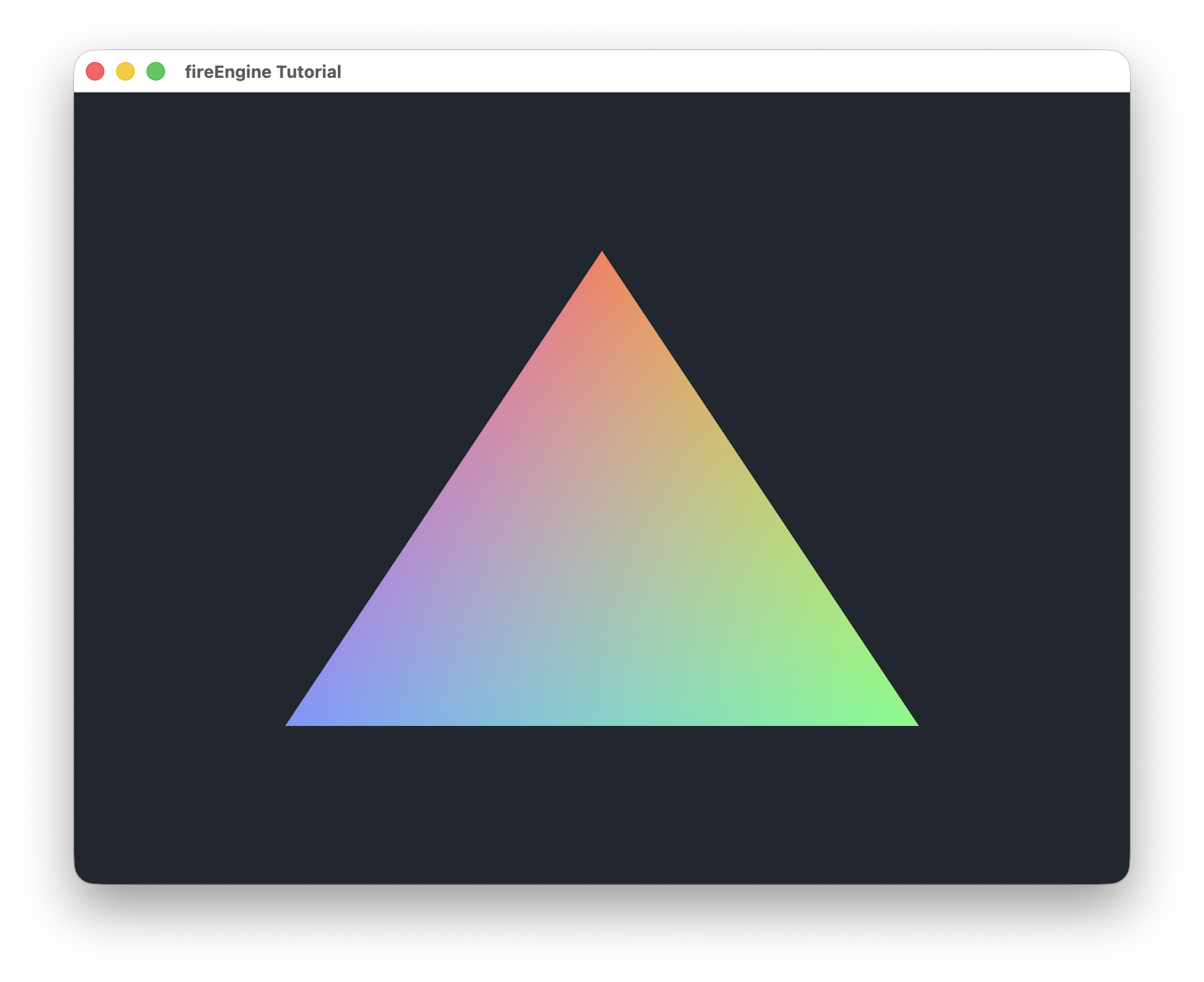 fireEngine’s first triangle, rendered through the release 0.6 frame loop.
The frame limit used for that capture is useful for a quick local check:
1
./build/fireEngineTutorial --frames 1
Without --frames, the same renderer continues presenting until the window is closed. The displayed image is a red, green, and blue triangle over the dark clear colour.
CTest exercises the bounded path directly:
1
ctest --preset default
Make CI prove a presented frame
The workflow file does not change, but its Linux test now proves the complete rendering path. Lavapipe inside Xvfb must create the buffers, acquire a virtual swapchain image, validate and execute the recorded commands, submit with the two semaphore scopes, and present one image before the 30-second timeout.
macOS and Windows continue to compile the same renderer without a compatible hosted-runner Vulkan environment. The platform-independent formatting, clang-tidy, and Doxygen jobs automatically discover the new source and header files. The corrected header filter makes that static-analysis claim real for the first time.
See the complete ci.yml.
Diagnose the new failure boundaries
Release 0.6 moves failures from startup construction into a stateful render loop. Validation in a Debug build is especially valuable because most mistakes are relationships between otherwise valid handles.
Buffer creation or upload fails
AllocatedBuffer names whether VMA failed during creation or upload and includes the Vulkan result. Creation failures point to the requested size, usage, host-access constraints, insufficient suitable memory, or driver state. An upload range error is caught before VMA and means the byte span or offset does not fit the allocation.
The first frame waits forever
The frame fence must begin signaled. On later frames, every reset fence must be paired with a successful graphics submission that will signal it. Release 0.6 acquires and records before resetting the fence specifically so the known early-return and recording-failure paths cannot strand it unsignaled.
Image acquisition reports an out-of-date swapchain
The window surface changed before an image could be acquired. The renderer returns eNotPresented without resetting the frame fence, main() performs its shutdown wait, and the application reports that recreation belongs to a later tutorial.
Validation reports an image-layout or access error
Check both ImageMemoryBarrier2 structures as a pair. The first must discard or match the current layout and make the image writable as a colour attachment. The second must occur after dynamic rendering, make colour writes available, and leave the image in ePresentSrcKHR. The image, view, and per-image semaphore must all use the same acquired index.
Validation reports missing dynamic state
The pipeline declares viewport and scissor dynamic, so both commands must be recorded after binding the pipeline and before drawing. Their extents should match the render area and current swapchain image.
Validation reports a descriptor mismatch
The push write must use set zero, binding zero, descriptor type uniform buffer, and a range covering exactly FrameUniforms. The pipeline layout and shader must retain the matching set, binding, type, stage visibility, and std140 memory layout.
Submission fails
The command buffer must be executable, the frame fence unsignaled, and the binary image-available semaphore waiting on exactly one acquisition signal. The wait stage must cover the first swapchain-image use, while the signal stage must not release presentation before colour output and the final layout transition complete.
Presentation is suboptimal or out of date
This is a surface-lifecycle result rather than a triangle-draw failure. Suboptimal presentation still increments the frame count before the loop stops; an out-of-date attempt does not. Release 0.6 exits cleanly instead of trying to replace swapchain images, per-image semaphores, and the format-dependent pipeline in place.
--frames is rejected
The option accepts one positive integer and no other arguments. Zero, negative text, trailing characters, missing values, extra arguments, and integer overflow all produce the usage error before Vulkan startup.
What release 0.6 gives us
Release 0.5 established frame ownership. Release 0.6 turns it into the first complete rendering and presentation path:
- one
AllocatedBufferowner pairs a Vulkan buffer with its VMA allocation; - host-visible sequential-write memory supports a simple first upload path;
- bounds-checked writes handle mapping and non-coherent flushes through VMA;
- one immutable vertex buffer stores three coloured vertices;
- each frame slot owns a std140-compatible 4×4 transform uniform;
- identity transform data is uploaded before the first submission;
Rendererowns triangle and frame resources while borrowing stable device, swapchain, and pipeline owners;- each frame waits for safe reuse before acquiring a swapchain image;
- acquisition happens before fence reset, preserving the out-of-date path;
- the whole command pool is recycled before one-use recording begins;
ImageMemoryBarrier2transitions the acquired image from discarded contents to attachment layout;- one dynamic-rendering colour attachment clears and stores the full image;
- dynamic viewport and scissor state follow the current swapchain extent;
- the pipeline, vertex buffer, and per-frame uniform are bound before drawing;
- a push descriptor supplies set zero without allocating a descriptor set;
- one non-indexed draw emits the three triangle vertices;
- a second image barrier makes colour writes available and transitions the image for presentation;
SubmitInfo2scopes acquisition and completion semaphores to colour output;- graphics submission and presentation use queues selected for their distinct capabilities;
- the render-finished semaphore follows the acquired image index;
- clean, suboptimal, and out-of-date outcomes preserve correct frame counts;
- normal and exceptional shutdown paths wait before renderer-owned resources are destroyed;
- the GLFW event loop remains application policy rather than renderer detail;
--framesgives automation a bounded success condition; and- CTest now proves one complete acquired, rendered, submitted, and presented frame.
The first triangle is intentionally static. There is still only one frame in flight, no staging buffer, no index buffer, no depth attachment, and no swapchain recreation. Those omissions keep the completed frame small enough to trace from host data to the presented pixels.
The next release can build on a known render loop rather than another startup checkpoint: animate per-frame data, overlap multiple frames, add depth and indexed geometry, or retire and replace presentation resources when the surface changes.
Recommended reading
- Vulkan Programming Guide — a detailed treatment of buffers, descriptors, command recording, image layouts, synchronization, queue submission, and presentation. Its examples predate current Vulkan, but the explicit resource and execution model remains valuable.
- How to Vulkan — a compact, code-first modern Vulkan guide whose buffer, dynamic-rendering, synchronization, and frame-loop sections provide a useful comparison with this tutorial’s Vulkan-Hpp RAII design.
The Reading page keeps the site-wide list in one place.